Pages

Friday, September 05, 2025

End of this Chapter

August 2025 marked 20 years of Tallahassee Karate club at North Florida School of Aikido.

This is a monumental accomplishment! We have been training together for 20 years! That’s very hard to believe. We started out with a very small class. We had times where up to 15 people were training at a time. But, time moves on people get older they quit due to physical reasons, job reasons, relocation reasons and many other reasons.

I think the first class may have had one person. Now, 20 years later, most Trainings only have one or two people.

In that 20 years, I’ve promoted less than 10 people to Shodan rank.

Being a Sandan, myself, I have only ever promoted one person to Nidan, as a matter of respect for a Dear student who had passed unexpectedly, In a tragic accident.

I never really wanted to have a commercial school or I would have pursued higher rank in an organization. Instead, I chose to teach a few dedicated students who were really just interested In the training, more than they were achievement of rank.

I have truly cherished these last 20 years of teaching at this location, but as they say all good things must come to an end.

September 2025 will be our last month of training at the dojo.

I would still like to continue teaching and training, but probably on a very small scale and in a more private and flexible environment. 

Thanks to everyone who has come along with me on this amazing ride of Kishaba Juku Karate, Yamane Ryu Bojutsu, and Kobudo. You all have been the reason we’ve kept it going so long!

Also, thanks to our hosts at North Florida Aikido who have provided us with an excellent venue for our training.

It is my sincere hope that everyone enjoyed the journey and will continue training in Karate for many years into the future!  I know you all made a huge impact on my life.


Thank you!

Bill Lucas

Head Instructor, Tallahassee Karate Club


Sunday, January 08, 2023

New Year's Day Training, 2023


We had a great turnout for the New Year's Day training!  It was a great start to the year with some Kihon and Kata. Looking forward to whatever this year brings!

2022 - End of the Year Recap


It's the end of another year. We trained at the dojo for most of the year, with an Omicron wave at the beginning of the year and a few weeks of Virtual training, thrown in for good measure.  We are an aging group, which means our training is not nearly as vigorous as it was just a few years ago.  We maintain, and  hopefully, improve with age, though.

Throughout the year, we focused on Naihanchi, and the other Kata.  We continue to work on employing the principles of a good naihanchi stance, relaxed joints, maintaining our centerline, evenly distributed stances, connecting our elbows, and extending our technique. We also worked a lot on Shirotaru no Kun and Kishaba Sensei's Kata, wich we just call Kishaba Kata.

This was a sad year, as Curtis McVey passed away, early on.  I will be forever grateful for his many trips to Okinawa to train with Sensei Shinzato, sharing what he learned through video, writings, and visits to our Dojo, over the years since 2010, and publishing a book about Sensei's karate methods.  

I was happy that a new person joined us for training in 2022, and was pleased to see the return of one of our long time students at the end of the year, while on break from College.

I hope that 2023 brings some new students into the dojo, continued good health and good training for all.  


Sunday, January 02, 2022

2022 - The Start

Starting out the new year with remote training, again.  I thought we were done with this, but since the Covid rates are so high in Leon County, it seems prudent to meet virtually again, until the rates decline, once more.

2021 was pretty good for the dojo. We started in-person training in March, and stayed at it throughout the year. On the average, we had 3-4 people per session. We had our 15 year celebration special training, and we had a student promote to Shodan.

Toward the end of the year, we focused on Shirotaru no Kun.  It was challenge, but I think everyone has it now.

 The new year always brings new possibilities. I hope, for Tallahassee Karate Club members, it will bring good health and good training!

Saturday, December 18, 2021

Naihanchi Points

I started writing this post a few years ago and left it in unfinished, draft form.  I opened it back up recently and re-read what I had written, and promptly deleted all of it.

Why would I do such a thing?

Because my perception of Naihanchi points has changed, like my perception of a lot of the principles we practice in Kishaba Juku.

I had written about how there are places in the Kata where you are coiled up, like a spring, and ready to go, much like the beginning of Naihanchi, or the places where you step across.

What I want to say about it now is a little different.

Naihanchi points are the places in the movement of the Kata where your feet come together, then move apart.  When you are at these places, you are ready to move in any direction.  You can change your mind.  The big difference now, is that when I think about Naihanchi Points, I think about maintaining relaxed koshi, instead of coiled, springlike (tense) koshi. I also think about maintaining my centerline over my center of gravity, keeping my elbows connected to my koshi, and then extending the technique as I move into the next position.

Naihanchi points are in all Kata, but it is hard to find them if you practice wide stances.  Our stances are quite narrow. In fact the heels, are basically, almost on the same line.  This is true whether we are doing natural stance, front stance, cat stance, or cross leg stance. If you were to draw an imaginary line on the floor, then stand over it in your stance, the left heel and the right heel would be touching opposite sides of the line.

The use of narrow stances enables the Naihanchi Point principle.  If the stances are any wider, you can't bring the feel together into the naihanchi point, and still maintain the same centerline throughout the movement.

The next thing is the position of the hips throughout the movement. Our hips maintain a somewhat open position, maybe 45 degrees. They never transition to a closed (hips completely forward) position at the beginning or end of the movement. This allows a connection on one side of the body, by aligning all the bones, and not creating any place where the connection is lost.

Moving the whole body as one unit, and maintaining the centerline throughout, are also key to finding the Naihanchi Point.

It is very difficult for me to actually write about this in a way that makes sense, so I may have to create a video to explain it further.  In the meantime, try it out. Experiment and see what it feels like.  Let me know your thoughts in the comments.


Friday, December 17, 2021

My Kata Improvement Cycle

Do - Watch - Correct - Repeat

Over the years of training and teaching, I have evolved a 4 step process for improving my Kata.

Step 1: Do.
Do the Kata. Or do a part of the Kata.  Record the Kata on video so you can proceed to Step 2.

Step 2: Watch.  
Take out that video you just recorded and watch it. Notice all the things you are doing wrong. Watch someone else do the Kata. Notice what they are doing right that you might be doing wrong. Watch videos of someone else doing the Kata. Notice their cadence. Is it different than your cadence.  Does it make more sense? Look for principles you may have wrong that are throwing everything else off.  

Step 3: Correct.
Pick something you just watched and work on fixing it. Over and over. This usually doesn't involve doing the whole Kata.  It could be a single technique or maybe an overall principle. Whatever it is, work on it. Try to fix it. Work to make it better.

Step 4: Repeat.
Go back to the beginning and repeat Steps 1-3.  Do this as any times as you need to to try and perfect whatever it is that needs perfecting.  Hint: it will never be perfect, but you might get pretty good at it!

Friday, March 27, 2020

Training during Covid-19

Tallahassee Karate Club has chosen to take precautions during the Covid-19 threat.  We have moved our twice weekly, at the dojo format, to a virtual training session.

It looks like many dojo are doing the same thing.

We have had 3 virtual classes, so far. I did the first one from my back porch, using Facebook messenger.  There were some challenges.  The internet connection wasn’t great. I don’t have a ton of bandwidth at my house and I was a ways away from my WiFi router.  Mosquitoes were present. Still, we made it work as best we could.  Space was limited so we did standing and moving basics, Naihanchi and Passai.

I moved to the garage for Training #2.  This was a challenge, as I needed to clean up enough to clear a spot big enough to do kata. We also switched to Zoom for the 2nd training.  I also set up my iPad so I could see everyone while they trained, and used my phone as the camera. This was much more successful than the first training, I think.  Zoom did present me with a message that said my session would be limited to 40 minutes, but it seemed to let us continue for an hour.  Once again, we focused on basics, Naihanchi and Passai.  I tested out the space before class and it appears I can do most of the other kata if I modify the stepping, a little.

Training #3 presented challenges with Zoom, so we ended up back on FaceBook messenger.  Still, it wasn't a bad training .

One of the best things about this virtual training is the ability for some of our former students, who have moved away, to join in and participate in training.  This allows them to reconnect with the class, and the Kata.

As we continue with this format, I hope it will get easier, and better, and the flow will feel as much like the regular dojo experience, as possible.

I really hope the pandemic runs its course quickly, but in the meantime, Tallahassee Karate Club will continue with Virtual Training.

Thursday, April 04, 2019

2019

I look back at 2018 and find I didn’t really blog at all in 2018.  Why?
Was it because I was lazy? Uninspired? I had nothing to talk about?  No.  It was a transition year.  I think I say that a lot.  My karate is always changing, transitioning.

Since 2014, I have been working to incorporate Shinzato Sensei’s latest principles into my karate.  It has felt like a 180 and there have definitely been times of frustration.  Here I am in 2019 and I don’t really feel I’ve made much progress.  Thinking back to my years in Kishaba Juku, it has always been thus.  I work to try to figure out a concept, then boom! New concept arrives and I have to try and figure that out.  This is the crux of Kishaba and Shinzato Sensei’s methods. You can’t rest on your laurels or think that you have it figured out, because as soon as you do, they change it up!

You might say, this goes against Traditional Karate methods of passing kata down from teacher to student without ever changing it...keeping the lineage pure.  This is not the way of Kishaba Juku. Instead, we look to constantly improve and refine.

For me the hardest part right now is to work on a simple relax and extend concept.  Relax, relax, relax, then extend. I never thought relaxing could be so hard!

As for the Dojo, we have a very small group at this time.  Everyone has their lives that keep them busy, including me.  We already only train two nights per week, but lately it seems we have more gaps in between than actual training time.

I hope to blog more this year. I hope to train a lot more this year. I hope to gain a working knowledge of Sensei’s new ideas.  Most of all I hope everyone has a great 2019!


Tuesday, January 16, 2018

2018

This is the first post in over a year!  I just did not feel much like posting last year, I suppose.  Classes at the dojo are small, these days.  We usually have 2-4 people, per class.  I hope that number will grow a little this year.

Mostly, we have been working on Shinzato Sensei's relaxed koshi principles.  These are pretty much 180 degrees reverse of what we practiced for years.  Someday, I may write about some of the transitions we have made throughout the years, but not today.

Here are a few ideas from our training at this time...

  • Start relaxed, stay relaxed, end relaxed
  • Open the koshi and let the joints relax.
  • Don't use muscular strength. Align the bones and simply extend.
  • Sink, then sink a little more, and extend. 
  • To transfer power, extend more quickly.
  • Let the top half of the body float on the bottom half.
  • Keep your centerline vertical.
  • "Test" the techniques with a partner to see if you can extend or retract them easily without tensing.
  • Don't tuck, don't squeeze, don't use your shoulders, don't wiggle your hips, don't over-extend, don't rotate, don't breathe hard and don't push.
  • Believe that it can work

We still do a lot of Naihanchi!

Happy 2018!

Tuesday, November 15, 2016

Haven't Posted in a Very Long Time

It's been over a year since the last time I posted anything here. At the Dojo we've mostly been working on relaxing and re-engineering our koshi principles to be in line with the way Shinzato Sensei is training now.

As usual, most training is centered around Naihanchi and the ideas therein.  It's a lot of work, and there are no quick results.

I have personally been spending a lot of time working on Shirotaru no Kun.  It's a very difficult, but exciting Bo kata.

Our class attendance is at an all time low as we near the 11 year mark, and I wonder if we have reached a plateau, if classes will pick back up in the new year, or if we should take it as a sign that it's time to move on...


Saturday, April 11, 2015

Progress on Naihanchi

I've been working on #Naihanchi a lot lately, trying to incorporate Sensei's relaxed power principles into my routine.  It's always hard to break old habits and do things a different way, but I usually learn something new in the process.

Here's a video clip from 2006 doing Naihanchi when our Dojo was on Orange Avenue.


Naihanchi Shodan 2006 - Orange Avenue Dojo


When I watch this now, I can see that I was able to generate pretty good power in my techniques, and they were well connected to the movement of my koshi, but I see a lot of lateral movement in my knees and a lack of connection of my elbows to my koshi.

Fast forward a few years and here I am, doing Naihanchi again...this time in our new Dojo on Capital Circle NW.


Naihanchi Shodan Jan 2010 - Capital Circle NW Dojo

This one is a little different, but still lateral knee movement.

Since about Dec. 2010, I've been working to change a number of body dynamics.  Here is a clip from 2014.


Naihanchi Shodan 2014

I think this one demonstrates pretty good connection, speed and power.  It seems to flow well.  It's not very relaxed though. I can see the tension in my shoulders and I was definitely tucking my koshi and squeezing my lats.

Here are a couple I took last night.  The first one is slow, focusing on relaxing everything and extending my technique from the connection between my elbow and my koshi.  The second one is the same idea only faster and throwing my technique off my koshi from the connection.


Naihanchi Shodan - April 2014 - Slow/Relaxed


Naihanchi Shodan - April 2014 - Faster/Relaxed

Needless to say, it's not where I want it to be yet.  There's a little too much hip rotation, instead of making that figure-8 koshi motion more internal.  There's still a little lateral knee movement, too.  I will continue to work, but I think it's a long way from 2006. 

If I can find some video from long ago, I might post that to show how my Naihanchi looked in say, 1983-1997.  That might take a while to dig up...


Sunday, November 30, 2014

Learning to Relax

For the last several years, I've been focusing on trying to do karate in a much more relaxed fashion.

For years I practiced to try to make a very fast and powerful technique by analyzing various body dynamics and ways to use my koshi (the area surrounding my pelvic girdle) to augment my power.  This process was very involved and complex and it took years for me to get some understanding of it.  I must say that I never really mastered it to the degree of satisfaction I would like.

Fortunately, in 2010, one of our fellow Kishaba Juku practitioners made the journey to Okinawa again to train with Shinzato Sensei, and like those old Chinese Envoys who took the Quan to Loochoo (Ryukyu) hundreds of years ago, he brought back information on Sensei's latest advancements in his study of Karate.

To say these new ideas (principles) were revolutionary for me would be an understatement, because I have been working on them ever since and not making the kind of progress I would like.  They are just a few principles, but they have had the effect of turning my karate training on its head, and really making me rethink how I train.  They include:
  • 50/50 stances (all stances derived from naihanchi)
  • Maintaining the centerline
  • Throwing the elbow off the koshi
  • Breaking balance/Dropping
  • Figure 8 koshi
and...
  • Relaxing!
The first 5 are what I initially took away from our Okinawan Envoy's journey, but the 6th one, relaxing, is what really is at the core of all the other 5.

I will probably spend some time talking about the first 5 at length in other posts, but in this post I'd like to focus on the 6th one, which, if taken in order of importance, should really be the 1st one.  

Anyway, here goes...

What does it mean to be relaxed in karate?

As karateka, we seem to constantly pursue making a more powerful and faster technique.  We want to be able to hit the heavy bag hard with a technique that penetrates.  We also want that technique to get to our target fast.  Unfortunately, doing this can have a tendency to develop tenseness in our technique. We tend to focus on using the muscles to make the technique.  We can get more speed and power by coordinating the technique with the rotation (and counter-rotation) of our hips, but if we are tense throughout the motion, the technique is held back by that tension.  Also, if we use only the muscles, we can only get so fast and powerful.

To really make power and speed, we have to relax.  It seems so counter-intuitive, but relaxing is the key.  All muscles have to stay relaxed throughout the motion, and the only tension should occur at the point of contact.  In that split second all the power of your body combines in that one striking point.  It's like Mr. Miyagi says in Karate Kid, "power of whole body, one inch..."

Sounds simple enough, right?  It's not.  Before you can find the way to make tension at the right moment, first you have to learn to relax.  Trying to relax throughout the performance of a kata is a very difficult thing.  There is a problem with relaxing, though. You have to learn to relax without compromising body structure. This is where the other 5 principles I list above come in.  But that will be the topic of another discussion.

For now, just relax.

Relax the knees. Feel bouncy.
Relax the koshi. Don't squeeze.
Relax the back.
Relax the lats.
Relax the shoulders.
Relax the neck.
Relax the arms.
Relax the hands. Don't squeeze them tight.
Relax your breathing.
Relax your mind.
Now make your first move in the kata...

Begin it relaxed. Stay relaxed as you move through. End the movement relaxed.

Enjoy!


Sunday, October 26, 2014

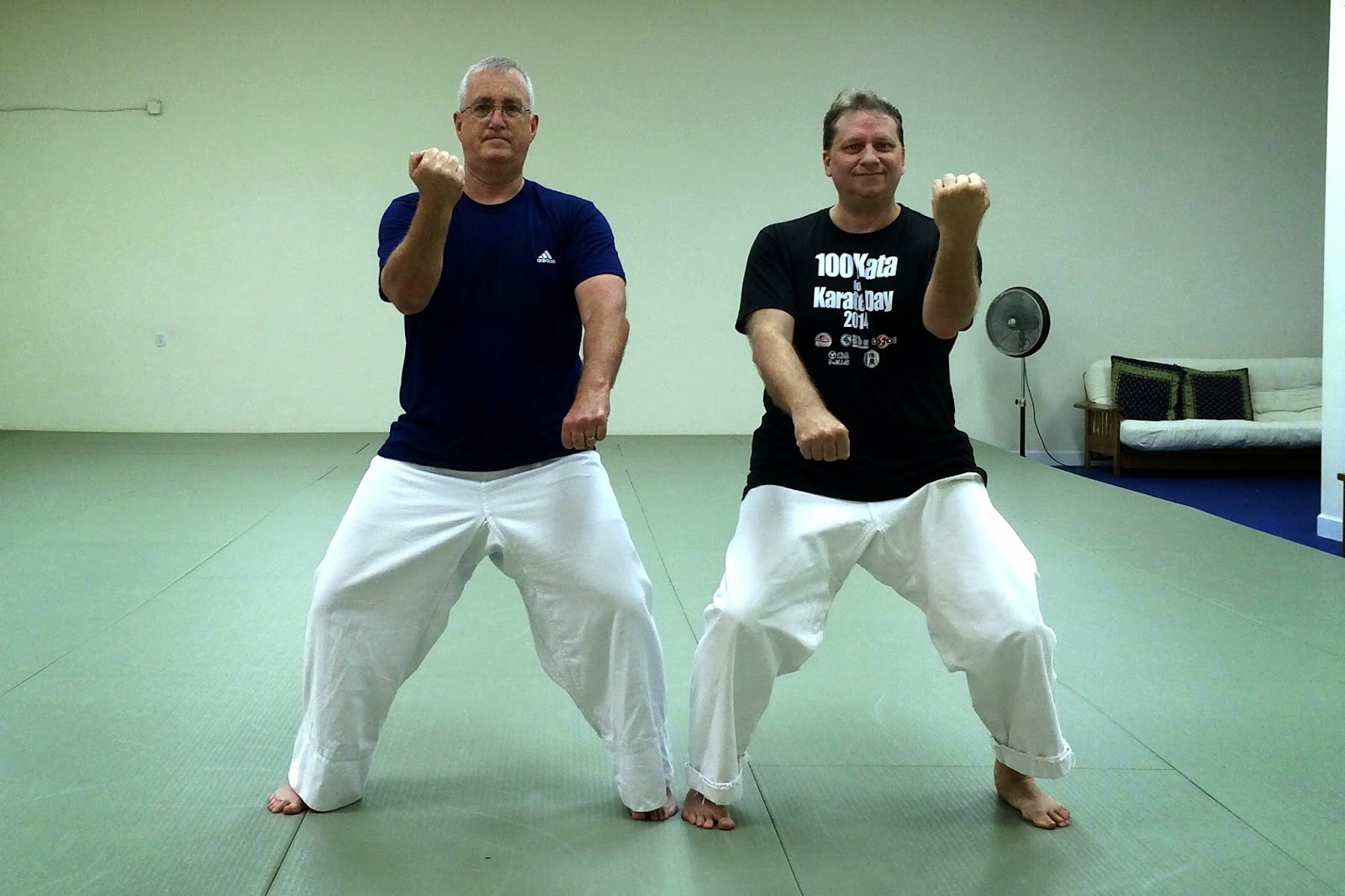
100 Kata for Karate Day 2014

On Friday, October 24th (25th in Okinawa), we practiced Naihanchi Kata for 100 times.  We did this to celebrate karate day, simultaneously with about 5000 karate practitioners worldwide!  In Okinawa, they did their kata in front of a castle at 6:00 AM.  We did ours in the dojo.

You can read more about the event here.

We did all three Naihanchi kata in sets of 10 each, and in a variety of ways.  It's was a great workout, and maybe we should try to do it once a month.

You can watch a playlist of our event here.


Sunday, May 04, 2014

April - Tonfa and Pinan Month

This year, like last year, we are going to try to dedicate each month to focus our training on some specific things. For April we picked Tonfa and the 5 Pinan Kata.

Tonfa is something we usually neglect in our training, so it was good to spend a whole month on it.  In our kata syllabus, we train in 2 different Tonfa kata: The original one I learned years ago from Sensei Harless, which we call "Tonfa 1", and another, more dynamic one I also learned from Sensei Harless, which we call, appropriately, "Tonfa 2".  These kata probably have official names, but I don't know what they are.

For warm-ups we focused on using the tonfa to supplement our normal stretching, loosening, blocking, striking, kicking routine.  I think it was a good addition.

Tonfa 1 introduces the swinging movements inherent in the use of tonfa. Tonfa 2 takes the swinging movements to higher level and adds very dynamic movement and footwork.

It had actually been a long time since I had practiced the Tonfa 2 kata, so I had to break out some old video footage to make sure I could remember it well enough to teach it.  No worries, though.  We've got it down now, so we'll just have to keep training on it so we don't forget it.  In addition to the two tonfa kata, we also practiced some Tonfa vs. Bo kumite.  It's good to practice weapon vs. weapon to get a feel for the distance and power required for actual usage.  It is an exercise that requires a lot of control so no one gets hurt, but it's very valuable.

We also practiced the 5 Pinan kata extensively in April.  We are currently focusing very heavily on maintaining relaxation throughout each kata, and only making tension at the part where the technique connects. Also, we're working on keeping our elbows connected to our koshi, throwing the technique off the hip, maintaining a 50/50-modified naihanchi stance throughout the kata, and dropping slightly as the technique occurs.  It's a lot of stuff to work on, but worth the exploration!

We worked on numerous applications for the Pinan kata including basic block and strike techniques, some grappling and throwing ideas, and defense against knife and stick weapons.

In May we will be focusing on Nunchaku and Naihanchi.  Check back later for an update!

Wednesday, January 01, 2014

Happy New Year 2014!

It's 2014! Hard to believe 2013 is behind us and we're almost halfway through the second decade of the 21st century!  When I was a kid, I actually thought we would be living in space by now.  Maybe I will see that in my lifetime.  I would love to practice Naihanchi on the moon or Mars.

2013 was our 8th year training together as Tallahassee Karate Club at North Florida School of Aikido.  We've had 8 great years of training together!  I'd like to thank the people who have trained with me throughout these years. Without you, there would not be a Tallahassee Karate Club.  I'd also like to thank my teachers in Okinawa Karate-Do Shorin Ryu Kishaba Juku for their dedication to the art, and invaluable training and patience with me throughout the years.  Finally, I'd like to thank North Florida School of Aikido for sharing their beautiful dojo with us.

I have a few personal training goals for 2014.  This year, I want to focus on getting into much better physical shape.  I think everyone has this goal, but for me, 2014 is going to be my year.  I would like to figure out a way to get back to Okinawa to train with Shinzato Sensei.  The last time (and only time) I was there was in Dec 2004-Jan 2005 (some blog posts about it here), and that is way too long! It's doubtful I will get there due to the money constraint, but I will keep it as a goal and see what happens. Beyond that, I just want to keep training and get better at the things I'm working on.

I have a few goals for the dojo, too.  I'd like to see us get a few more regular students. I wouldn't mind starting a kids class. I really want to have at least 4 special trainings this year. 6 would be better! I would also like to take the dojo over to train with Janos Sensei more this year.

Happy 2014 and may your year be filled with Karate training!

- Bill

Monday, September 02, 2013

Special Training & Promotions - August 31, 2013


We had a very special 3 days of training and promotion demos this Labor Day weekend.  Friday class ran at the usual time and we focused on running through all the kata from Naihanchi through Kusanku. Everyone was energized and ready to train, and it was good to spend the whole class just going though all the kata.

Saturday was the big day.  Janos Sensei drove over from Panama City and led us through an amazing 3 hours of training that has surely left everyone's brains on full!  We worked on koshi and movement principles from Naihanchi, Chinto, and Kishaba no Sai.  We enjoyed Janos Sensei's quick wit and example-driven teaching style.  His demonstrations of Chinto against the wall, and how to defend yourself with a shirt over your head, will not be forgotten soon.  He encouraged us to "find naihanchi in all stances and movement" and that is just what we will continue to do.

After training on Saturday, we had promotion demos.  Demos included, 3 Shodans, a Yon-Kyu and a Shichi-Kyu.   It was great to see so many spectators for the demos, including my other Teacher, Steve Harless. Everyone did amazing as they performed numerous kata and applications.

As a special event, we performed a demo in honor of Carol Strickland.  I performed a Sai Kata (Carol was very fond of Sai), Eli performed a Nicho Gama kata from his previous style, Dave did Pinan Sandan, and we all performed Pinan Shodan.  After us, our special guests, Leslee Williams Sensei and Dan Zimmerman, performed Naginata two person forms that Carol had been working on when she was training in Naginata.  It was a wonderful tribute to an amazing martial artist who left us too early.

At the conclusion of the day, the karateka were awarded with their new ranks and I presented a posthumous Nidan for Carol.

Sunday morning training was focused on 3 hours of nothing but Kobudo.  I can honestly say I'm exhausted now and very much enjoying having Labor Day off to just rest!

Congratulations to all who promoted and thanks to my Sensei for both being there!


Shodan Essay: Confidence

Confidence and its Necessity in Karate-Do

By Eli Jones


Image of the various brush-stroke styles for the kanji for self-confidence


Religion calls its faith, commerce calls it security, athletes call it tenacity, and general society calls its self-assurance. The Japanese word for it is jishin which, depending on the kanji, can mean earthquake. Regardless of moniker, confidence is an element of the human mind that is dependent upon a combination of two factors: an individual’s perception of a given scenario (whether spontaneous or routine) and his or her perceived ability to take appropriate action as necessitated by a situation. In daily life this can mean anything from trusting family and friends to provide emotional, spiritual, or financial support when required (general confidence) to a warranted standing of one’s ground with peers, colleagues, or superiors on the basis of a technical, practical, or personal issue (self-confidence). Generally speaking, an amalgamation of common and life-changing experiences and how they are handled is what ultimately shapes an individual’s self-perception while establishing a perpetual pattern of action, or lack thereof. That is to say, if a person learns to handle undesirable situations with quick resolve, they will retain the confidence to do so, and if one becomes used to mistreatment, it is unlikely that he or she will ever gain enough confidence to break the cycle. 

        With that said, confidence presents itself in a number of ways with regard to martial arts. In karate specifically, karateka are often given opportunities to demonstrate their ability before sensei, students, and spectators; challenged to learn new forms and applications; charged with the task of sharing knowledge with others seeking karate-do; required to apply learned skills in a controlled environment in both prearranged and free-style scenarios; and, with time, tested to gain the privilege and responsibility of acquiring new knowledge. Needless to say, as the student spends years learning his or her respective style, self-assurance tends to be a product of the physical, mental, and spiritual growth that karate-do affords its practitioners. Such confidence typically translates to the student’s life outside the dojo as a tendency to welcome new experiences, handle daily stresses in a productive manner, take leadership roles in his or her community, strengthen ties with family and friends, establish healthy relationships, and, should the unfortunate situation arise, defend one’s self and loved ones to the fullest extent. 

        I am thankful to say that the cumulative product of my twenty-one years in karate training has led to a more confident me than would have resulted had I never discovered the Okinawan art. As with many who find their way into the arts, my interest was sparked by way of American commercialism. In my case, it was the 1984 movie
The Karate Kid – which I first saw in 1987 – that sent me relentlessly begging my parents to let me take karate. Five years later, I found myself in a traditional Shorin-ryu dojo training under Major J.D. Perry, USMC (retired) who was then a fifth dan in Nakazato Shugoro’s Shorinkan style. 

        As with most kids starting off in karate, my initial goal was progression – to ascend the ranks, learn techniques to impress friends, and essentially become the next Daniel Russo. I very quickly discovered that true karate was not designed as a mode of status or entertainment, and, as one might guess, lacks the commercial elements presented by inspirational underdog movies of the 80s, comedic anthropomorphic reptile cartoons of the 90s, and (as recently noted) octagon-oriented ultraviolent free-for-alls of the new millennium. Conversely, karate is a personal commitment and lifelong pursuit to better oneself through training; a term that typically refers to a continued dedication to the analysis, interpretation, practice and overall comprehension of the form. It was through these points that I was able to understand, even at a young age, the substance of empty hand and the emptiness of preconceived substance. 

        At around age twelve, I witnessed other kids boast about black belts they had obtained a year after joining whatever commercial dojo they were a member of, only to lose in the numerous fights they inevitably got themselves into. Upon speaking to one of these young karateka, I found that their dojo trained with safety proofed and artificial weapons, based a great deal of importance on competition, and encouraged its students to speak out about training – likely for the sake of commercial attention. The underlying issue with this type of dojo was that its students developed a false sense of confidence hinged upon poor training and a belief that they were more capable in combat situations than was actually the case. When these young karateka discovered that they were unable to “use” karate as originally thought, the resounding effect was a lack of confidence in their training and ultimately themselves. 

        Perry Sensei, on the other hand, insisted that no child should hold a yudansha rank. His belief was, and still is, that even a well-trained child cannot physically defend his or herself in a direct confrontation with an adult, and, as such, is incapable of handling the responsibility that comes with a black obi. Similarly, he disagreed with the use of “toy” weapons on the grounds that a child will never learn respect for the implements of kobudo, and will harm themselves or others should they ever use authentic articles. On the subject of openly discussing one’s ability as a martial artist – he highly discouraged it, once comparing the notion to an individual of inadequate intelligence warning everyone he crosses that he carries a concealed hand weapon (Sensei added that even with a gun, a fool rarely knows how to use the weapon appropriately and will likely harm himself and others). It was such fundamental differences between Sensei’s approach and most others’ that gave me confidence in both Shorin-ryu and the dojo at which I was training. 

        I continued through the remainder of public school with a sense of self-assurance granted by a martial arts experience that placed me under several gifted sensei as a student, and before classes of fellow karateka as sempai – this is essentially where I discovered my love of communication and speaking to large groups. Shortly after graduating high school, I found myself in college training to be a skin therapist where, interestingly enough, I discovered that many of the same body areas used to incapacitate an attacker can be used to encourage wellness in a client. After graduation, I went back to school, became a teacher, and taught skin care at the college where I had learned. Soon, I found myself married, taking a job three states away from my home state, and enrolled in college yet again – all of this occurring in just ten years’ time, and all requiring personal confidence to carry through. 

        For the first two years after the move to Florida, I found myself in a town that seemed to be dominated by what I have so affectionately come to call “buy your belt here operations,” or as my friend Dave Higgins likes to call them, “McDojos.” It was for this reason that my training became very personal during this period. The reason I note this is because it requires a sufficient amount of confidence in one’s karate-do to understand that, in certain cases, it is best to train on one’s own than to risk the influence of bad information or improper training with others. 

        Nevertheless, my wife and I soon moved to Tallahassee where, after about four months, I found another Shorin-ryu dojo. Here, Sensei Bill Lucas teaches Kishaba Juku, a martial arts study group founded by Chokei Kishaba where Katsuhiko Shinzato now serves as the Juku Cho. Although this form of karate is indeed Shorin-ryu, the techniques seemed somewhat foreign to me as I originated in a style that focused on the generation of power through body mechanics and the augmenting of strength; Kishaba Juku, however, places a similar emphasis on body mechanics, but utilizes a combination of koshi (hip) technique and relaxation to generate power. At first, I wasn’t sure how this karate worked – or how it could work rather – and after three years of training, to be completely honest, I’m still not one-hundred percent certain. But I did become certain of one thing very quickly – Kishaba Juku is authentic Okinawan karate at its best, it works, and is most definitely effective. 

        Over the course of these last few years, both Lucas Sensei and Paris Janos Sensei have demonstrated the importance of relaxation in karate which has, by extension, finally started to translate into my daily life. When I first came to Kishaba Juku, I often remained rigid in my demeanor, techniques, and applications, and was constantly told by Lucas Sensei to “just relax.” At first I thought this difficulty was confined to my martial arts training, but soon found that I was equally as tense in life outside the dojo. It really was not until a doctor’s visit several months ago when a nurse told me that my blood pressure was once again high, and the doctor diagnosed me with a stress-induced issue that I realized, “I’m not relaxing.” With this revelation, I decided to practice deep breathing techniques, eat healthier, train more, and focus exclusively on issues that are solvable. In doing this, my most recent checkup showed that my blood pressure had normalized (without medication), the symptoms of my issue were minimal at worst, and I felt that my overall outlook on life had improved significantly. In other words, by relaxing I was able to build energy and generate more power on a life level. The reason I mention all of this is because there is really nothing more of a confidence-booster than realizing that the ideas and values learned from an essential component of one’s life, such as karate, has implications on such a broad level as to affect every other component. It is for this reason that I am confident that my current method of training will continue to improve all aspects of my life now and well into the future. 

        On a final note, it is important to understand that confidence should not be confused with arrogance, just as assertiveness should not be confused with pushiness. As mentioned earlier, confidence relies on the individual’s perception of a situation (typically a gauging of situational gravity) and his or her believed ability to act in that situation. Arrogance, on the other hand, generally stems from the notion that the beliefs, knowledge, or skills possessed by one are innately correct and superior to those held by others. In truth, the misguided arrogance of one can shatter the progressing confidence of others. And if we accept that a shattered confidence is not easily reassembled, we can understand why such frames of mind have no place in the karate-do. Confidence, however, is not only a good idea – it is fundamentally necessary.  

Shodan Essay: Character

The Meaning of Character in Karate Do

By David Higgins


                Character is defined in Webster’s dictionary as: “Strength of mind; resolution; independence and individuality” and “moral quality; the principles and motives that control the life”. Why is this important to a karate-ka? In karate-do character has two roles.  A karate-ka of good character knows when to restrain himself and dreads the day he has to use his skills. The training of self defense comes with responsibility that requires people of morality and peace. The techniques are real and dangerous and it takes discernment and a clear mind to decide when and how much force to use. As Shoshin Nagamine said, “There is no first strike in karate. It must remain purely a self defense art from beginning to end.” By incorporating the ideas of peace, respect and non-violence we also see a change in the karate-ka outside of the dojo.

     The Okinawan idea of peace, respect and courtesy to opponent is vital when it comes to “character” and its place in karate-do. Our style in particular, Kishaba Juku, is a true self defense art.  We all bow to one another; we are polite and genuine to one another. In the dojo, we build each other up through collaboration teamwork rather than divide on competition. Karate training is a constant conflict with oneself and through that conflict everyone grows spiritually and physically together. The social aspect of Karate-do is obvious in kumite. Kumite requires complete trust in your partner. It also builds and develops self control and restraint. At any given point one person can seriously be injured or killed. This is why we want karate-ka of good moral character that will only use their skills as a last resort in self defense. Heart of a saint and fist of a devil; we want people of morality and justice guiding the use of such an art.

     Strangely enough, I came from a competitive martial arts background that was based on striking first. Kishaba Juku is my first traditional style and it has completely changed my life in many different ways. I’ve dedicated myself to non-violence and the no first strike precept along with the other precepts of Matsumura. My attitude towards others has changed and I find that I am more polite. By training in kumite and kata, I handle stress differently and with a clearer mind. I am not as quick to anger and I respect all people, even if they are hateful. To me, kata is the most important aspect of any martial art. It teaches an inner peace and calm. It also, through constant repetition, builds instincts and reaction. Through diligent training in all of these characteristics I have changed how I react to life in general.

     By building all of these characteristics I have become a better person over the last 6 years of training in Kishaba Juku. I respect my martial art and understand what it can do, through that I show a large amount of restraint and never get into physical confrontations at all. This comes from the teachings of respect, courtesy, honor and nonviolence. The development of my character has greatly changed because I have embraced these ideas and made them a part of my life.


Kanji Source:
http://www.saiga-jp.com/cgi-bin/dic.cgi?m=search&sc=0&f=0&j=&g=&e=character&s=&rt=0&start=1&sid=1377793496_87925

Shodan Essay: Perseverance

Perseverance

By Christopher Danello


Charles Swindle said, “Life is 10% what happens to you and 90% how you respond to it.” This is the concept behind the Kishaba Juku rule: “Fall 7, Rise 8.” That rule has become a mantra for me. I keep it as a sign on my desk. Whenever I find myself running into a wall – which is often – I remind myself to fall seven, but rise eight. Perseverance is defined as a steady course of action despite obstacles. Life puts up walls. Survival of the fittest is not so much won by the strongest or the smartest. It’s more often won by the more dogged and relentless. The one that continues to rise.

One of the things I found while searching for the Perseverance Kanji, was that it is often associated with the Kanji for Patience. This is no accident as Perseverance teaches the hard lesson of Patience. This is one of the main lessons I have learned through Karate. It’s easy to get frustrated with the very slow and difficult uphill climb in learning Kishaba Juku Karate. I have heard this mentioned over the years from other members who came from other disciplines. This is not a quick fix study. It’s not a place for Rank Collectors. It is a long, slow, methodical process that will only take time. It’s easy to walk away when the walls appear. This is where you must cultivate the Patience to Persevere. From what I’ve heard, Kishaba Juku is structured for just that purpose. It’s no accident that Kishaba Juku deemphasizes the rank of colored belts; having just the four from white to black. I think back to the story I heard that the Kishaba Juku belt is really the same belt that has worn and stained over the years. First turning green from tumbles outside. Later to brown as the stains age and new ones are added. Then finally to black as stains and age compound. The underlying theme of that story is that Kishaba Juku takes time. It takes Perseverance.

One of the obstacles I’ve experienced in Kishaba Juku is constant challenge; the constant sense of starting over. One way this has manifested is in my lack of experience. Most of the people I’ve come to know in Kishaba Juku, came to this study from another discipline – Shotokan being the most prevalent name I’ve heard. I have no previous background in any form of martial art. I came to Kishaba Juku completely wet behind the ears. Watching others adopt styles and moves (seemingly) with ease has been hard at times. Again and again, I found myself frustrated because it didn’t seem to come to me “so easily”. I had to remind myself that it’s not coming to them so easily to them; and it hadn’t in the past. They are on a different path than I am – or at least a different part of the path. So again, it comes back to time and Patience. Another way I‘ve seen constant challenge is in the fact that nothing is ever truly conquered. Nothing is ever complete. That’s a hard pill to swallow. No kata is ever truly “mastered”. There are always refinements to be made. Or the kata changes in subtle ways. Or when I reach a comfort level in one kata, there’s a new one to learn – each one making me feel like a novice all over again. There’s never really a point where you cross the finish line and think “There, I’m done.”. Like many, I think I came to Kishaba Juku believing Shodan was the end goal. Over time, I’ve learned how far from the truth this is. It’s not an end; it’s a signpost to the next part of the journey – with more Falls to Rise from. As I approach Shodan, I realize I don’t have the Grand Knowledge I thought I’d have at this point. Instead a I have a grasp of how much more I have to learn. Always at these times, I remember the Peaceful Warrior saying, “Shodan is when you start learning.”. I now see Shodan much more as a new beginning and new growth; the next phase. Again, it comes back to time; which comes back to Patience and Perseverance.

Another obstacle I’ve faced (and this has really come out in Karate) is myself. So much more than the running or weight lifting, Karate is where I see that I need to learn how to get out of my own way. One way this manifests is in me is in self fulfilling prophecy (psyching myself out). I’ve noticed that often the truly easy moves have tripped me up every bit as much as the really difficult ones. I remember early on, that I just could not get the move in Fukyugata Ichi after the second high block turning into the series of reverse punches. I could never set my feet properly. I literally couldn’t figure out what move preceded that series. Finally one night, Mike saw me struggling and said, “Hey man, you’re over thinking it. You just shift your right foot over; that’s it.” But I had convinced myself that there had to be something more complex there. It couldn’t be that simple. And yet it was. A similar move tripped up in Gojushiho as well. That scenario has replayed itself time and time again through the years. It has revealed a weakness in me and demonstrates how Perseverance is a lesson I continue to need. I continue to convince myself that I just can’t do it; that it’s too hard. In the absence of walls, I put up my own. Another lesson in getting out of my head has been in learning to see failure as a part of the process. Like Shodan, failure is not an end point. It’s an opportunity for improvement. That too has become a favorite saying of mine as people who’ve taken my classes will attest. Failure was often been the ultimate wall for me. Walking away became a skill of its own. More than with other endeavors, Karate has taught me that failure is a stepping stone. It’s literally a chance to step back and say, “Why didn’t that work? Where to next?”. That is the lesson of Perseverance; not breaking the walls or ignoring them, but find the way around them through relentless pursuit. And it’s a lesson I’m still learning.

Probably the main way Karate and the lesson of Perseverance has influenced me in other parts of my life would be the weight loss. This was a classic example of an area where I allowed the walls to turn me back. Time and again I gave up because it was too hard, and took too much effort for what I saw as too little result. I wanted it right away, just like I wanted Shodan right away. However, while learning this process of Patience and Perseverance in Karate, I began to apply those principles to diet and nutrition. I stopped trying to find the magic bullet or the grand effort that would turn my life on a dime. I instead began to focus on the gradual collection of methods and moves; adding new techniques to earlier learned techniques, the same as we do in Kishaba Juku. Friends talk about my weight loss as if it was a night and day thing. But I tracked the entire process. The chart stretches across two years. It is a slow gradual downward slope which is riddled with little turns back upward (failures where I had to reassess). That was the trick all along, time, Patience and Perseverance. I had to see the end goal of someday. I had to accept that where I was now was where I was now. There was nowhere else to be. I was on a path and had to keep walking. This is by far the biggest thing I’ve picked up from Kishaba Juku; all things in time. Arguably, this same lesson is what led to success with running – this notion of building on successes and learning from failures. No one just up and runs a marathon. I tell people you have to build up. Start with running this distance. Then try adding this much. That’s a lesson I learned from Kishaba Juku. First this move. Then add this one. Now put them together in this kata. Small moves. People tell me how ‘disciplined’ I am, but to me, that is the other side of the coin for Perseverance – Patience on one side, Discipline on the other. And it’s a lesson I’m nowhere near done learning.

So where does the path lead? If Shodan is a signpost, where to next? I find myself entering a more creative phase in my study of Kishaba Juku. Much like learning music, learning to play the instrument, eventually, you have to make the song your own. It has to become a part of you and your own expression. I feel the same with Karate. I must now learn to make these moves an extension of myself and not just motions I memorized. I need to find, not what they mean, but what they mean to me. Again, this is how I interpreted the Peaceful Warrior’s statement, “Shodan is when you start learning.”.

And as Kishaba Juku Karate has influenced other aspects of my life, I’m hoping this lesson on Perseverance will influence other creative endeavors. This is the main reason I chose to draw the kanji for Perseverance. It was miniature lesson in Perseverance. Drawing has never been a strong suit for me. However it teaches the needed lessons of Patience and Discipline. It teaches Perseverance. This is something I have never had in my own preferred creative endeavor, Fiction writing. I must have a file of no less than 4 dozen half-written short stories, novel ideas, movies, entire serials; all stopped before the finish. I have tended to walk away when something got too bogged down or to tedious or when I just couldn’t figure it out. Sound familiar?! Most everything for me in Kishaba Juku Karate has been too hard, tedious or something I just couldn’t get. Time and again, there have been kata I just hated; mostly because I couldn’t get my head wrapped around them. And time and again I have eventually begun to wrap my head around each one and usually the ‘most hated’ has become my ‘favorite’. Lately, I’ve been asking myself more and more, “Why can’t I apply this same method to my fiction?”. Everything I need for Fiction is there for me in Kishaba Juku: structure, building on small concepts, putting things together, learning from failures, learning Patience, learning Discipline, learning Perseverance. I read an article where the narrator was speaking to a writing class and asked them, “How many of you want to be Writers?”. Many enthusiastic hands. He looked around, then said, “Now. How many of you want to Write?”. Hands crept down in slow descent. And there it was, wanting and doing are two different things. I would have been one of the descending hands. People want the short route whenever possible. In Kishaba Juku, there is no short route. It must unfold in a natural progression. It unfolds slowly and gradually, but it does unfold. I need to bring the lessons of Patience and Discipline – Perseverance to my fiction world. That is the fan to ignite the sparks that I’ve to often stared at thinking, “What if?”.

I find myself looking at Kishaba Juku with a sense of rebirth. I now see a path that stretches further into the distance than I had realized before. The journey is truly just beginning. I have at least a glimpse of how vast this terrain really is and how much more there is to learn. That’s what I’ve picked up in Kishaba Juku. The lesson is never truly complete. There is always somewhere to tweak, a variation of a move, a new way to look at a kata, the resurrection of an old way. There is always somewhere else to take it. Perhaps perpetual motion is the essential definition of Perseverance – never stopping.

Saturday, August 31, 2013

Carol Strickland, Nidan

This post is in honor of Carol Strickland. Carol was a senior member of our dojo until she tragically passed from the physical bonds of this earth due to a diving accident in the Florida Keys in 2010. Carol was preparing for her Nidan (2nd degree black belt) promotion, at the time.


Carol was always training, both in and out of the dojo.  In addition to karate, she also trained in naginata a couple times per week, she did boot camp fitness workouts at 5:30 AM and had even done some krav maga.  She was the consummate martial artist and in class she was a leader.  Her presence is still felt and she will always be a part of our dojo family.


I would like to formally recognize Carol Strickland, posthumously, as a Nidan in Kishaba Juku Shorin Ryu Karate.


The following is the essay she wrote as part of her Nidan promotion requirements.


What Karate has Done for Me
By Carol Strickland

When I was 25 years old, in 1983, I began studying karate because a friend pulled me into the dojo with her. She wanted to learn karate and talked me into going with her.  Before we went into the dojo, I became very sick, but still managed to make myself go in.  I knew absolutely nothing about karate or the etiquette.  I felt very out of place.  I learned the style of karate we were going to do was Matsubayashi Ryu. The Instructor (sensei), Steve Harless, was very nice and had someone take us in the back room to learn some basics.  We continued in the back room learning for several weeks before we joined the class.  I continued learning for for the next six years receiving my black belt in 1988.  I had to leave karate for a while, when I adopted a special needs 7 year old boy.  As a single parent, this required lots of time and attention.  In August 2006, after my son was grown, I wanted to start back in karate. I started looking at websites when I came across Bill Lucas' name.  This was someone I trained with before.  He was now a Sandan teaching Kishaba Juku.  I was excited to begin my training and was glad there were some similarities between the two styles.  I have been training again for almost 3 years,

Karate has helped me in all aspects of my life.  It gave me the confidence to do many things I never thought I would be able to do or attain.  Karate has helped me deal with stress, to stay focused, and to persevere.  First, I probably would not have had the courage or confidence to adopt as a single parent if it had not been for my karate training.  I found out very quickly that living with a special needs child greatly adds to everyday stress.  My training in karate gave me the ability to cope with this stress.  Second, I was able to go to school as an older adult and attained my bachelor's degree.  I knew if I could train in karate and receive my black belt that I should be able to stay focused and stick with earning my bachelor's degree which I did in 2005.  Third, when I returned to my karate training I knew I needed to lose some weight.  Losing weight is a battle for anyone who is overweight, but knowing that fitness is an important part of martial arts training helped me stay focused and persevere to lose almost 100 pounds!

There are multiple benefits anyone can gain from training in karate.. Karate can not only give someone the knowledge of self defense, it can also teach them to deal with conflicts without using violence.  Karate can improve ones fitness and strength.  It can also help with flexibility and balance.  Training in karate can help one with their concentration and self discipline.  It teaches one to control their emotions, to cope with stress and to show respect.

In the future, by continuing to train in karate, I hope to be able to encourage others to be successful and to give them a sense of self-worth.  At some point, I would like to teach karate to children that had a bad home life or are in foster care, so they have more self-esteem.  I also want to be able to discipline my mind and my spirit more.

Little did I know at the time I started karate that it would lead to lifelong learning in everything I do.  Becoming a black belt meant becoming a lifelong learner (just the beginning).  I have learned that I have little knowledge and skill in karate and there is always more to learn.